
A guide for drivers in Bracknell, Dorking, Redhill and the surrounding roads of Surrey and Berkshire
You’ve been in an accident. The damage looks manageable, maybe a dented bumper, a cracked light, some panel damage. The car is driveable.
You book it into a body shop, the repairs are done, and it comes back looking as good as new. Job done.
Except it might not be.
If your car was built in the last five to ten years, the chances are it is fitted with Advanced Driver Assistance Systems – ADAS. Lane-keeping assist, automatic emergency braking, blind-spot monitoring, adaptive cruise control, parking sensors or rear cross-traffic alert.
These systems are not decoration. They are active safety technology, and they depend on sensors and cameras that are calibrated to tolerances measured in millimetres. An accident, even a relatively minor one, can shift those sensors without leaving a visible mark.
And if they are not recalibrated correctly, you may be driving on Surrey’s roads or the M25 with safety systems that appear to be working but are not actually functioning within manufacturer specifications.
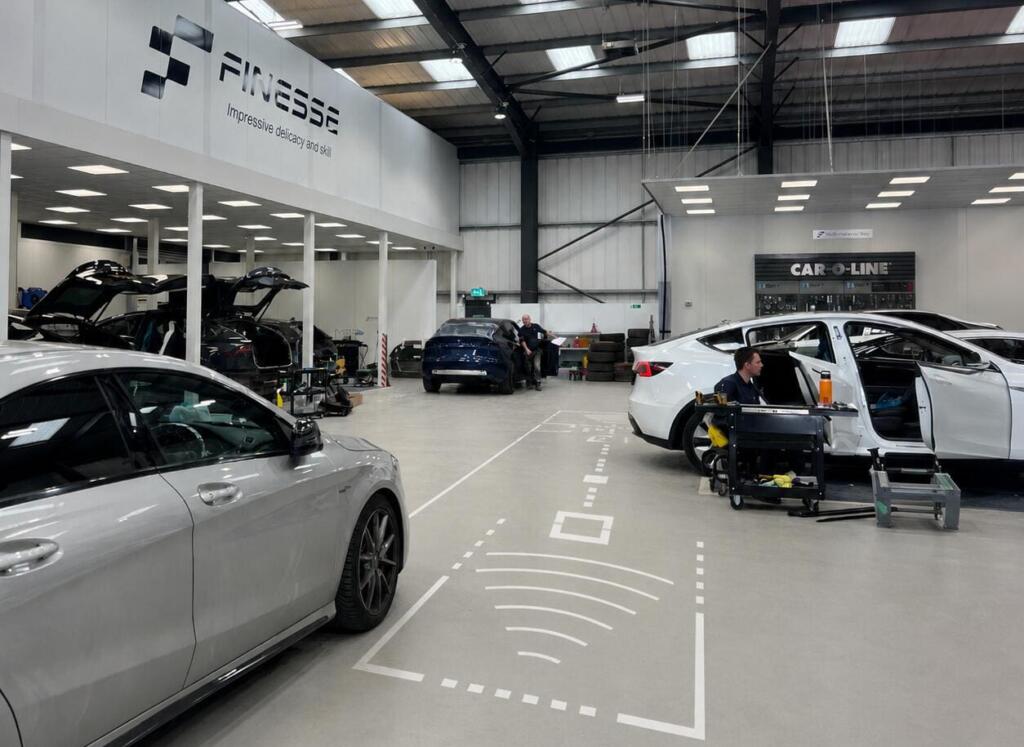
Every manufacturer Finesse is approved by specifies when ADAS recalibration is required as part of their repair procedures, and Finesse follows those procedures on every repair.
This guide explains what ADAS recalibration is, which accidents and repairs trigger it, what the warning signs are, and how to ensure it is carried out correctly. It is for drivers in Bracknell, Dorking, Redhill and the wider Surrey and Berkshire area, where modern vehicles are increasingly common on the A3, A31, M25 and surrounding roads.
What is ADAS and why does it need recalibrating after a repair?
ADAS is the umbrella term for the Safety and Driver Assistance Systems now standard on most new cars. In vehicles approved by manufacturers including Audi, BMW, MINI, Tesla, AION, Volkswagen, SEAT, CUPRA and Volvo all of which Finesse Accident Repair Centres is approved to repair, these systems are integrated into the structure of the vehicle.
Cameras are typically mounted behind the windscreen or in door mirrors. Radar sensors sit behind the front bumper and grille, or at the rear. Ultrasonic sensors are embedded in bumpers. All of these require precise physical positioning to function correctly.
When a vehicle is involved in a collision, several things can happen:
- The physical mounting point of a sensor or camera can shift, even fractionally
- Replacement panels, bumpers or windscreens can alter the precise angle of a sensor relative to the road
- Structural repairs or wheel alignment work can change the vehicle’s geometry in ways that affect how sensors read the road ahead
- In some cases, the repair process itself, removing a bumper cover, for example, can disturb sensor alignment even if the sensor was not damaged
A sensor that has shifted even fractionally may appear to function normally. Warning lights may not show. The car may pass a basic visual inspection without any obvious issue. But on a motorway at speed, the difference between a sensor aimed correctly and one that is even slightly out of alignment can mean the difference between an emergency braking system that responds and one that does not.
Which accidents and repairs trigger the need for ADAS recalibration?
This is where many drivers are caught out. It is easy to assume that recalibration is only needed after a major crash. In reality, the triggers are much broader than most people realise.
Repairs that almost always require recalibration
- Front bumper repairs or replacement, radar sensors for adaptive cruise control and forward collision warning are typically mounted here
- Rear bumper repairs or replacement, affects sensors for parking assist, blind-spot monitoring and rear cross-traffic alert
- Windscreen replacement, the single most common recalibration trigger, cameras for lane departure, emergency braking and speed sign recognition are mounted to the windscreen bracket
- Door mirror repairs, side-view cameras and blind-spot monitoring sensors may be disturbed
- Wheel alignment, changes in steering geometry affect how forward-facing sensors interpret the vehicle’s direction of travel
- Suspension repairs or frame straightening, alters vehicle ride height and geometry, affecting the angle of radar and camera sensors
- Quarter panel repairs, side-mounted radar sensors for blind-spot detection require precise positioning
How to check your ADAS systems are working after an accident: a step-by-step guide
Use the following steps after any accident repair involving your vehicle’s bodywork, suspension or glass, whether the repair was carried out at Finesse or elsewhere.
Why does it matter whether your repairer is manufacturer approved?
Manufacturer approval is not a marketing badge. It is a set of technical requirements that a repairer must meet and maintain, including specific diagnostic equipment, OEM repair data access, certified technician training and regular auditing by the manufacturer.
For vehicles with ADAS, these requirements are directly relevant to whether your safety systems can be correctly restored. Manufacturer-approved repairers have access to the exact calibration procedures, target measurements and software tools specified by the vehicle’s manufacturer. Non-approved repairers may use aftermarket calibration tools that are not validated against the manufacturer’s own specifications.
Finesse Accident Repair Centres holds manufacturer approvals for Audi, BMW, MINI, SEAT, CUPRA, Skoda, Tesla, Volkswagen, AION and Volvo, brands whose vehicles are among the most technology-dense on UK roads. Each approval requires Finesse to follow the brand’s specific repair methods, including ADAS recalibration procedures.
A repair that passes a visual inspection is not the same as a repair that restores your vehicle’s ADAS systems to manufacturer specification. The difference is only visible on a diagnostic scan, or on the road when a safety system fails to activate when it should.
Why this matters for drivers on Surrey and Berkshire roads
Drivers in the Bracknell, Dorking and Redhill areas are among the most frequent users of the M25, A3 and A31, roads that regularly feature high-speed incidents, lane changes and stop-start congestion. These are exactly the conditions in which ADAS systems are most heavily relied upon: adaptive cruise control managing motorway following distances, automatic emergency braking responding to sudden stops between Junctions 8 and 12 on the M25, lane-keeping assist holding position on the dual carriageway sections of the A3 near Guildford.
They are also roads where the consequences of a miscalibrated safety system are most serious.
If your vehicle has been in an accident on any of these roads and has been repaired, confirming that your ADAS systems are correctly calibrated is not a technical detail. It is a safety check.
Frequently asked questions about ADAS calibration after an accident
Q: Can I drive my car if the ADAS calibration has not been done?
A: Legally yes, but it’s important to know that our vehicle may have safety systems that appear active but are not functioning within specification. Warning lights may not appear, but systems such as automatic emergency braking or lane departure warning may not activate correctly in a critical situation. If you are unsure whether calibration has been carried out after a repair, contact a manufacturer-approved repairer and request a diagnostic scan.
Q: Does ADAS recalibration affect my manufacturer warranty?
A: It can, in both directions. If ADAS recalibration is required after a repair and is not carried out correctly, it may affect your warranty claim in the event of a future incident involving those systems. Conversely, a completed ADAS calibration certificate from a manufacturer-approved repairer demonstrates that the systems were restored to factory specification, which protects your warranty position.
Related Articles
Finesse Bracknell: Your AION-approved accident repair centre
AION Approved Accident Repair Centre Bracknell A new car can change what you expect from driving. But the real test of ownership often comes [...]
How to check your ADAS systems are working after an accident
A guide for drivers in Bracknell, Dorking, Redhill and the surrounding roads of Surrey and Berkshire You’ve been in an [...]
Finesse Appoints New MD and Group Operations Manager
Finesse Accident Repair Centres Strengthens Leadership Across Bracknell, Dorking and Redhill Finesse Accident Repair Centres has strengthened its leadership team with two senior [...]

We are a proud sponsor of the Tesla Owners Club
Finesse is a proud sponsor of the Tesla Owners Club, reflecting our commitment to electric vehicle repair excellence.
As one of the UK’s leading Tesla approved accident repair centres, we provide manufacturer-approved repair using advanced equipment and trained EV technicians across Bracknell, Dorking and Redhill.
We support Tesla owners across Redhill, Reigate, Horley, Dorking, Bracknell and surrounding Surrey and Berkshire areas with repairs you can trust.
 Locations
 Approvals
 FAQ’s
FAQ’s Services
 Contact