
Structural Car Body Repairs in Bracknell, Dorking and Redhill
When a vehicle is involved in a serious accident, the damage visible on the surface is rarely the full picture. The chassis, the crumple zones, the structural reinforcements behind the panels: all of it needs to be assessed and, where necessary, restored to the tolerances the manufacturer specifies. That is what structural car body repair is.
Finesse Accident Repair Centres carries out structural car body repairs at our centres in Bracknell, Dorking and Redhill.
Every repair is completed using manufacturer-approved methods, precision alignment equipment and genuine OEM parts. We are approved repairers for Audi, AION, SEAT, CUPRA, Skoda, Tesla, Volkswagen and Volvo, and we follow each brand’s specific structural repair procedures on every vehicle.
What does structural car body repair involve?
Structural damage affects the parts of your vehicle that maintain its shape, absorb energy in a collision and protect the occupants. After an accident, these components must be restored to their original geometry before any cosmetic work begins. A vehicle that looks repaired on the outside but has unaddressed structural damage is not safe and may not perform correctly in a future collision.
At Finesse, structural repairs typically include some or all of the following, depending on the extent of the damage:
Structural work
- Chassis and frame alignment using precision measuring systems
- Crumple zone assessment and repair or replacement
- Structural panel welding and bonding to OEM specification
- Structural panel repair and replacement to manufacturer specification
- Subframe inspection and realignment
- High-strength steel repair using manufacturer-approved techniques
Always carried out alongside
- Pre-repair diagnostic scan to identify all affected systems
- Wheel alignment check following any structural correction
- ADAS recalibration where sensors are in or near the repair area
- Post-repair diagnostic scan to confirm system functionality
- Calibration certificate provided on completion
- Full quality check before handover
Signs your vehicle may have structural damage
Structural damage is not always obvious after an accident. Some signs appear immediately. Others develop over days or weeks as the vehicle settles. If your car shows any of the following after a collision, a structural assessment is needed before any further use.
Sign
What it may indicate
Uneven panel gaps after repair
Indicates the chassis geometry has shifted and panels are no longer correctly aligned to the structure beneath.
Vehicle pulling to one side when driving straight
Suggests the chassis or subframe is out of alignment, affecting steering geometry.
Unusual vibrations through the steering wheel or floor
Can indicate frame distortion, particularly after a front or rear impact.
Doors or windows not closing correctly
Suggests the door aperture has shifted, indicating structural deformation in the body.
Visible creasing or folding in structural panels
Shows the impact has gone beyond the surface and into the structural layer beneath.
ADAS warnings or unusual sensor behaviour after a collision
Structural misalignment can shift sensor mounting points, affecting calibration and system function.
How Finesse carries out structural car body repairs
- 1
Full damage assessment and pre-repair scan – Your vehicle is inspected in detail to determine the full extent of the structural damage, including any damage not visible from the outside. A pre-repair diagnostic scan identifies any fault codes across all electronic systems before work begins, giving us a clear baseline and ensuring nothing is missed.
- 2
Repair plan and authorisation – Based on the assessment, we produce a complete repair plan specifying which structural components need repair or replacement and which approved methods will be used. Where the repair is insurance-funded, we submit this plan to your insurer for authorisation and manage the process on your behalf.
- 3
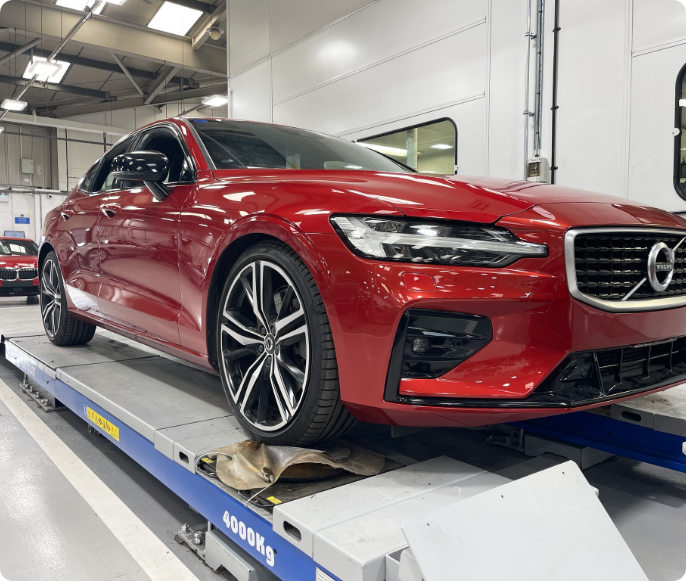
Structural alignment and repair – The vehicle is placed on our precision chassis alignment system and measured against manufacturer tolerances for your specific vehicle. Structural components are repaired or replaced using the correct methods for your vehicle’s construction, whether that is high-strength steel welding, aluminium bonding and riveting, or a combination of both.
- 4
Wheel alignment and geometry check – Once structural repairs are complete, wheel alignment and steering geometry are checked and corrected to manufacturer specification. Structural repair without a geometry check is incomplete. Any misalignment at this stage affects handling, tyre wear and safety.
- 5
ADAS recalibration where required – Where the structural repair has affected the mounting points of ADAS sensors, cameras or radar systems, recalibration is carried out to manufacturer specification. This is not an optional add-on. It is part of a complete structural repair.
- 6
Post-repair scan, quality check and handover – A final diagnostic scan confirms all systems are operating correctly. A full quality check is completed before the vehicle is returned. You receive documentation of all work carried out, including calibration records where applicable.
Why manufacturer approval matters for structural repairs
Structural repair is the area where manufacturer approval makes the most difference. The tolerances involved are precise. The materials vary between brands and even between models. The approved methods for welding, bonding, riveting and alignment are specified by the manufacturer and differ from generic bodyshop techniques.
Finesse holds manufacturer approvals from Audi, Cupra, Seat, Skoda, Tesla, Volkswagen, Volvo and AION. Each approval requires us to follow that brand’s structural repair procedures, use genuine OEM parts and maintain the precision equipment required to carry out the repair correctly. Our centres are audited by manufacturers to verify compliance.
A structural repair carried out to manufacturer specification restores your vehicle’s crash performance as well as its appearance. The crumple zones, the reinforcements, the weld points: all of it matters in a future collision. That is why we do not take shortcuts on structural work, and why the approval matters.
Structural car body repairs at our Bracknell, Dorking and Redhill centres
All three Finesse centres carry out structural car body repairs. Contact your nearest centre or submit your details online and we will call you back to arrange an assessment.
Unit 2-3 The Sterling Centre, Bracknell, RG12 2PW
01344 203058
Serving Bracknell, Wokingham, Ascot, Sandhurst and surrounding Berkshire areas.
Lincoln Road, Dorking, Surrey, RH4 1TD
01306 743 030
Serving Dorking, Leatherhead, Guildford, Reigate and surrounding Surrey areas.
Unit 40d Holmethorpe Avenue, Redhill, RH1 2HL
01737 307400
Serving Redhill, Reigate, Horley, Crawley and surrounding Surrey areas.
Frequently asked questions
Q: How do I know if my car has structural damage after an accident?
A: The most reliable way to confirm structural damage is a professional assessment using precision chassis measuring equipment. Some signs you can look for yourself: uneven gaps between panels after a repair, the vehicle pulling to one side when driving, doors or windows that no longer close correctly, unusual vibrations through the steering wheel or floor, or ADAS warning lights that were not present before the accident. If any of these appear after a collision, bring your vehicle in for an assessment before driving it further
Q: Will structural repairs affect my manufacturer warranty?
A: Not when carried out by a manufacturer-approved repairer using genuine OEM parts and approved methods. Finesse holds approvals from Audi, SEAT, CUPRA, Skoda, Tesla, Volkswagen and Volvo. All structural repairs are documented and carried out to each manufacturer’s specified procedures. Using a non-approved repairer for structural work, or one that does not use genuine parts, carries a risk of warranty non-compliance.
Q: Do structural repairs include ADAS recalibration?
A: Yes, where required. Structural repairs often affect the mounting points of ADAS sensors and cameras. Any structural work that changes the vehicle’s geometry, including chassis alignment, suspension repair or panel replacement near sensor locations, will require ADAS recalibration as part of the repair. At Finesse, we carry out pre and post-repair diagnostic scanning on all structural repairs and recalibrate ADAS systems where the repair requires it.
Q: Can structural damage be repaired or does the car need to be written off?
A: Most structural damage can be repaired when assessed and addressed correctly by a manufacturer-approved repairer. Write-off decisions are made by insurers based on the cost of repair relative to the vehicle’s value, not solely on whether the damage is structural. Finesse carries out assessments and provides detailed repair estimates that give you and your insurer a clear picture of what is involved before any decision is made.
Q: How long do structural car body repairs take?
A: This depends on the extent of the damage and the parts required. Minor structural repairs can be completed within a few days. More extensive structural work, particularly where multiple components need repair or replacement, can take one to two weeks. We provide a clear timeframe at the assessment stage and keep you updated throughout. Courtesy vehicles are available at all three centres while your car is with us.
Q: Do you carry out structural repairs on aluminium vehicles?
A: Yes. Finesse has a dedicated aluminium body repair capability at all three centres. Many modern vehicles, particularly those from Audi, Tesla and AION, use aluminium-intensive construction for structural components. Aluminium requires different repair techniques to steel, including specific bonding, riveting and welding methods. Our technicians are trained and equipped for aluminium structural repair to the relevant manufacturer specifications.